
Blog › Peptide Units Explained: mg, mcg, mg/mL and IU
Peptide Units Explained: mg, mcg, mg/mL and IU
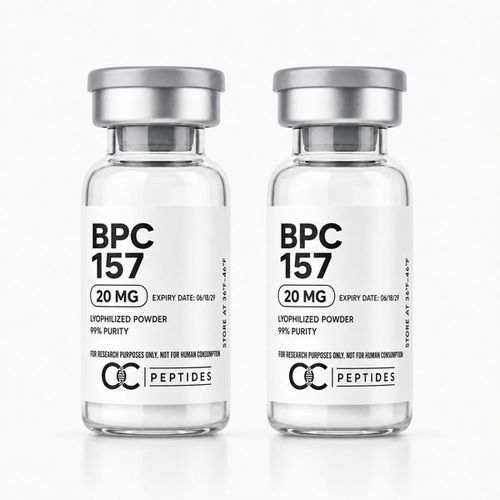
Research peptides are sold, labeled and discussed in several different units, and mixing them up is one of the easiest ways to make a calculation error in the lab. This reference explains the units you will see on Central Coast Peptides product pages and vial labels, how they relate to each other, and where a direct conversion is not possible.
Mass: milligrams and micrograms
Most peptides are sold by the mass of peptide in the vial, written in milligrams (mg). Smaller amounts are often written in micrograms, abbreviated mcg or µg. Both are standard metric prefixes on the gram (NIST):
- 1 gram (g) = 1,000 milligrams (mg)
- 1 milligram (mg) = 1,000 micrograms (mcg or µg)
- 0.1 mg = 100 mcg, and 0.05 mg = 50 mcg
The most common mistake is a factor of 1,000. If a calculation gives an answer that seems far too large or too small, check whether mg and mcg have been mixed.
A note on writing: "mcg" is often preferred over "µg" in handwritten notes because a smudged µ can be misread as an m. Pick one convention for your lab notebook and use it every time.
Concentration: mg/mL and mcg/mL
Once a lyophilized peptide is reconstituted, the useful number is concentration, the amount of peptide in each milliliter of solution:
- Concentration (mg/mL) = peptide in the vial (mg) ÷ solvent added (mL)
For example, a 10 mg vial reconstituted with 2 mL of solvent has a concentration of 5 mg/mL. That is the same as 5,000 mcg/mL. Each 0.1 mL of that solution holds 0.5 mg, or 500 mcg.
More worked examples:
- 5 mg vial + 1 mL solvent: 5 mg/mL, so 0.1 mL holds 0.5 mg (500 mcg)
- 5 mg vial + 2 mL solvent: 2.5 mg/mL, so 0.1 mL holds 0.25 mg (250 mcg)
- 10 mg vial + 2 mL solvent: 5 mg/mL, so 0.1 mL holds 0.5 mg (500 mcg)
- 10 mg vial + 3 mL solvent: about 3.33 mg/mL, so 0.1 mL holds about 0.33 mg (333 mcg)
Our free reconstitution calculator does this math for any vial size and solvent volume, and lists the amount held at every 0.1 mL mark.
Volume: milliliters and microliters
Volumes in peptide work are usually in milliliters (mL). Very small volumes are written in microliters (µL):
- 1 mL = 1,000 µL
- 0.1 mL = 100 µL
When you move between pipettes calibrated in µL and glassware marked in mL, convert before you calculate, not after.
International Units (IU)
A few products, such as hCG and HMG, are labeled in International Units (IU) rather than mg. An IU measures biological activity, not mass. Each substance's unit is defined against its own reference standard; the World Health Organization's Expert Committee on Biological Standardization maintains these international standards.
Because the definition depends on the substance and the reference preparation, there is no single conversion between IU and mg. Never convert IU to mg with a factor taken from a different compound. Record IU-labeled material in IU, and work out solution strength as IU per mL:
- IU/mL = IU in the vial ÷ solvent added (mL)
Percentages on a specification
A purity percentage, such as 99%+ by HPLC, describes how much of the material is the target peptide relative to related impurities. It is not a unit of amount and should not be multiplied into a concentration calculation unless your protocol specifically calls for it.
Quick reference
- 1 mg = 1,000 mcg
- 1 mL = 1,000 µL
- mg/mL = vial mg ÷ mL of solvent
- mcg/mL = mg/mL × 1,000
- IU/mL = vial IU ÷ mL of solvent (no general IU-to-mg conversion)
Keep your records consistent
Write the unit next to every number in your notebook, on every aliquot label and in your inventory log. A concentration written as "5" without a unit is the start of most unit errors. For more on storage after reconstitution, see How to Store Lyophilized Peptides.
All Central Coast Peptides products are sold strictly for laboratory research use. They are not drugs, foods, dietary supplements, or cosmetics, have not been evaluated by the FDA, and are not for human or veterinary use. This article is a units reference for laboratory calculations and does not provide dosing guidance.